Enterprise SaaS Leadership Insights
What is Payment Orchestration?
A clear, practical definition of payment orchestration
What Payment Orchestration Actually Means
Payment orchestration is a system-level layer that sits between your business and your payment providers.
It does not process payments itself.
Instead, it decides how payments behave.
It determines:
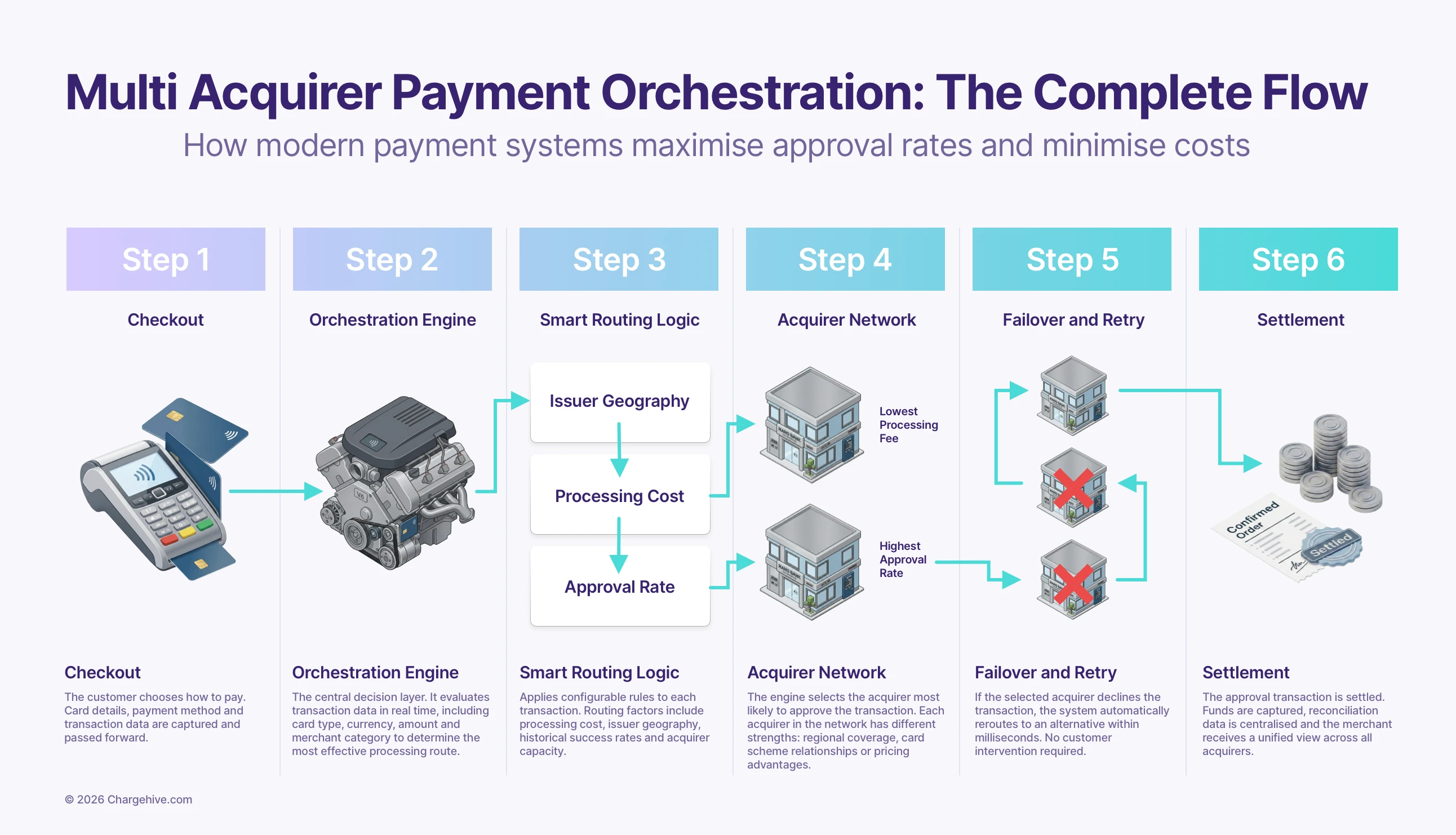
Which provider a transaction is routed to
What happens when a payment fails
How retries are handled
How tokens are managed
How compliance rules are applied
How outcomes are monitored across regions and products
In large, global SaaS businesses, this layer becomes the place where payment behaviour is standardised and controlled.
Without it, payment behaviour is usually defined by whatever provider, region, or engineering team happens to own a particular flow.
That may work at small scale.
It does not work when you are operating across multiple providers, countries, products, and billing models.
Why This Distinction Matters
At scale, payment behaviour tends to fragment.
Some logic lives inside provider dashboards.
Some sits in application code.
Some is embedded in regional implementations.
Some exists in operational processes and runbooks.
No one sets out to design it that way. It simply evolves.
Over time, payment behaviour becomes:
Distributed
Duplicated
Difficult to reason about
Hard to change without risk
With orchestration, that behaviour is pulled into a dedicated layer. A layer built specifically to manage complexity on purpose rather than inherit it accidentally.
That difference is subtle at first.
It becomes critical as you grow.
Why the Term “Payment Orchestration” Exists
There was a time when payments were relatively simple.
You chose a primary provider.
You integrated their APIs.
You relied on their tooling for retries, reporting, and failure handling.
For many businesses, that was enough.
But that model does not survive hyper-scale.
In a global SaaS organisation with hundreds of thousands or millions of customers:
Different regions rely on different providers
Subscription renewals follow different rules from one-off charges
Legacy payment flows coexist with newer ones
Retry logic varies between products
Compliance requirements differ by geography
Payment behaviour stops being centralised. It becomes scattered.
And once behaviour is scattered, no one truly owns it.
The term “payment orchestration” emerged to describe the response to this reality. A dedicated layer whose job is to coordinate payment behaviour across an increasingly fragmented ecosystem.
In simple terms, orchestration exists because modern SaaS businesses outgrow the idea that one provider, one integration, or one team can define payment behaviour everywhere.
What Payment Orchestration Is Not
The term gets used loosely, so it is worth being clear.
It is not a Payment Service Provider
Payment service providers execute transactions.
Orchestration determines how and where those transactions are executed.
It is not a Gateway
Gateways provide connectivity.
Orchestration governs logic across gateways, processors, and acquirers, especially when more than one is involved.
It is not Billing Software
Billing systems define pricing, invoicing, and entitlements.
Orchestration focuses on what happens once a payment attempt is made. Execution. Reliability. Recovery.
It is not just Smart Routing
Routing is one capability.
Orchestration also includes:
Retry strategy
Token lifecycle management
Compliance handling
Observability
Failure recovery
All coordinated within a single system.
And importantly, orchestration is not about ripping out your existing infrastructure.
In large SaaS organisations, payment systems are deeply embedded. Replacing them wholesale is risky and unrealistic.
Orchestration sits alongside them. It introduces coordination without requiring everything to be rebuilt.
Infrastructure, Not a Feature
Payment orchestration should not be viewed as a feature you switch on.
It is infrastructure.
It becomes necessary when payments stop being a background utility and start behaving like what they really are at scale: a core operational system.
When failures impact revenue in measurable ways.
When latency affects customer experience.
When blind spots undermine confidence in reporting.
At that point, the question is no longer whether you need better dashboards.
It is whether you have real control over how payments behave across your business.
And that is a system-level decision.
———
Last updated: 3rd March 2026
It's Time
At hyper-scale, the limitations of CRMs, payment tools and stitched-together systems become unavoidable.
Tell us where the friction is and we’ll show you what it looks like once it’s gone.